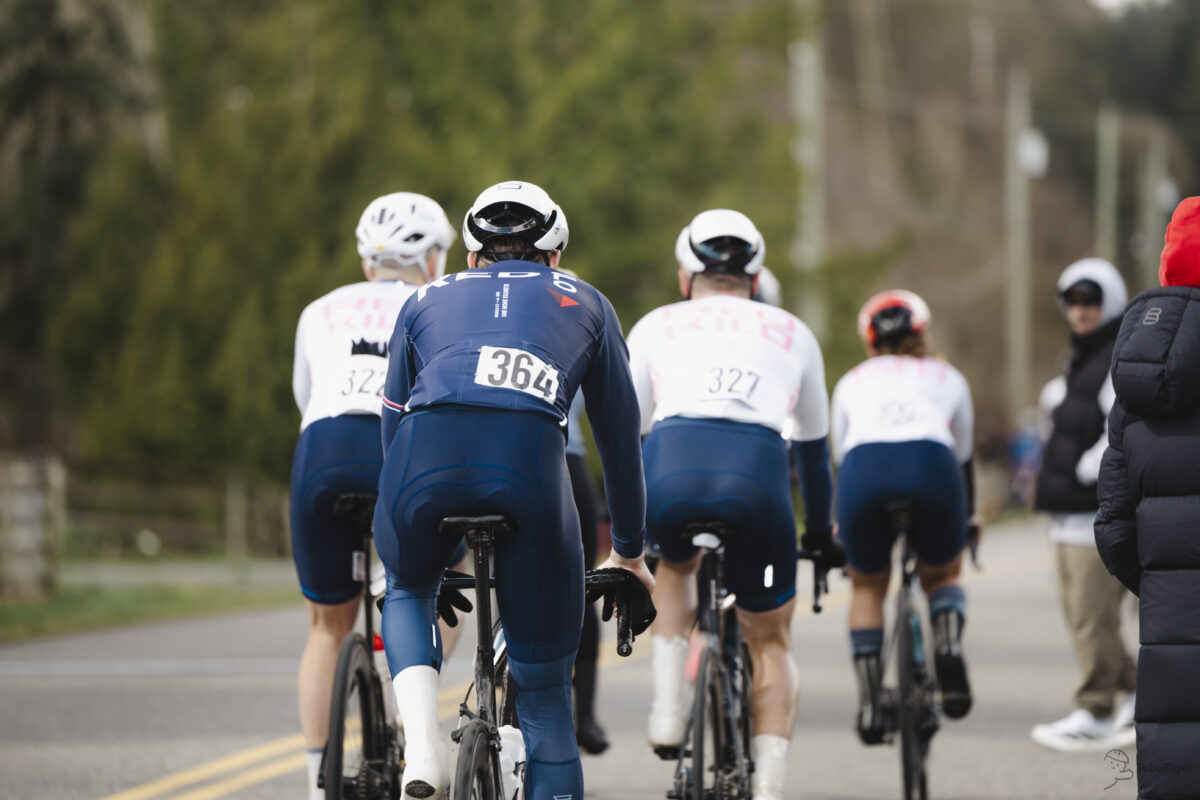
I registered for the Masters category (male bike racers over 35 years old) at a race last Saturday but at the last minute myself and three other Masters-aged teammates changed our entry to the ability-based Category 3 (no age restriction). It got the other Master racers talking and asking why, mostly because our switching out of the Masters race made their race less interesting.
Here’s my response, something I’ve been working through the pros and cons of for a few years now (and am still uncertain about):
I think the big Masters team in BC should be congratulated and encouraged for fielding so many of their teammates in the race yesterday—racing with your mates is more than half the fun. You shoudn’t have to tell some of your buddies to race a different category. So it’s not the big teams outnumbering my team that led to myself and three other Red Kilo riders switching out of Masters at the last minute. It’s because I’m with you—in a way—on distributing Masters back to Cat 3&4:
I think we should all race, and only race, our ability level. Disband and disperse Masters throughout the BC racing cosmos (i.e. send us back to Cat 1-2, Cat 3, and Cat 4 from whence we came). We’re a small sport in a small nation with even smaller weather windows. Subcategories do more harm than good.
Here’s why:
- Improve overall racing in BC:
More than a couple top Cat 1-2 racers have, rightly, lamented the decimation of the Cat 1-2 field since Masters took off in BC 10 years ago1. Cat 3 fields with ten guys rolling around—the category that’s supposed to produce Cat 1-2 (and then pros and olympians). - Masters has gotten stale:
Masters is basically the same guys year after year: we know each rider’s name and their dog’s name and the exact watts you sprint with and the exact gradient I attack on. - Mentorship:
An opportunity for old guys to show newer races tips and tricks, and (perceived or real?) issue with the generational change in traditional club mentoring. - Ability levels:
Masters often has grizzled former pros racing beside Cat 5s. Dangerous, but worse, not so fun to get dropped immediately every week.
I say this after taking advantage of a super large, fun, and competitive Masters peloton these last 10 years. And now I want to eclipse it with categories again? Fair point. But the price has been too high.
Noted exceptions: the Masters “beer league” category on the weekend was huge, looks like they had a lot of fun. Can’t blame ’em: the regular Masters is literally Cat 4s racing with us former Cat 2s, I can see how that wouldn’t be entirely fun. And 37 racers in Cat 1-2 is one of the biggest and highest quality BC has seen in years.
More exceptions and restrictions acknowledged: insurance, yellow line pack size limits, sketchy riders aka safety. Really it’s the damn weather that we should be trying to fix—by far the biggest factor in turnout in half the races in BC. I don’t think road bike racing in Canada will ever be big enough to fully overcome these things like, say, in Europe, so I also want to work with what we have right now.
Counter: these good and bad turnouts are part of the usual ebb & flow I’ve seen in 32 years of racing. Meanwhile road racing’s gravity remains but a tiny moon among sporting planets, even among cycling disciplines. I wonder if that’s why fondos and gravel events are so popular: huge anonymous groups with subgroups to get dropped with. Less ego, more timing chip, and safer (sort of). We attract one or two riders from the stars of our local fondo scene over to our road racing satellite every year. I want to attract dozens.
Can’t support bigger packs (the weekend race was limited to 50 per start wave)? Get better insurance. We already do races that allow larger. Maybe larger entry numbers would support that. And more diversity of riders in the larger packs can lead to harder faster racing, less 5-guys-across-the-road-for-3-hours, more strung out, more groups to get dropped and roll with.
Sketchy riders? My theory is almost no category has more crashes than any other. And in Masters we’re already mixing more ability levels than almost any other category.
Combining Masters with say, Category 3, then separating us in the results after the finish is one of the concessions I like.
Is there some trend and truth to thinking our governing body, Cycling BC, is embarking on a new direction along these lines, too? Loosening the restrictions that were designed for larger cycling nations? Adding category flexibility? I was encouraged—shocked—they let me race Cat 3 on the weekend when my license says Cat 2.2 Which is, I’m slowly admitting to myself, the bigger of the lies: I ended up 20th in Cat 3 and feel like I was hit by a car today.
So, we all race Cat 3 next weekend?
- Should be noted prior to and overlapping with the 2010 years there was an entirely separate and dedicated masters-aged racing league in BC, with its own events and organizers and even Facebook group. On the whole it was a bit off the radar of most young racers, and sort of fizzled out in the early 2010s, maybe because of the rise of the mainstream Masters I’m now talking about. ↩︎
- In British Columbia, for a few years now, you can put your age-category as well as your ability-category on your race license and, if an organizer offers both at their event you can choose one or the other (exceptions are championship and higher level events, where you must race Masters). ↩︎
Leave a Reply